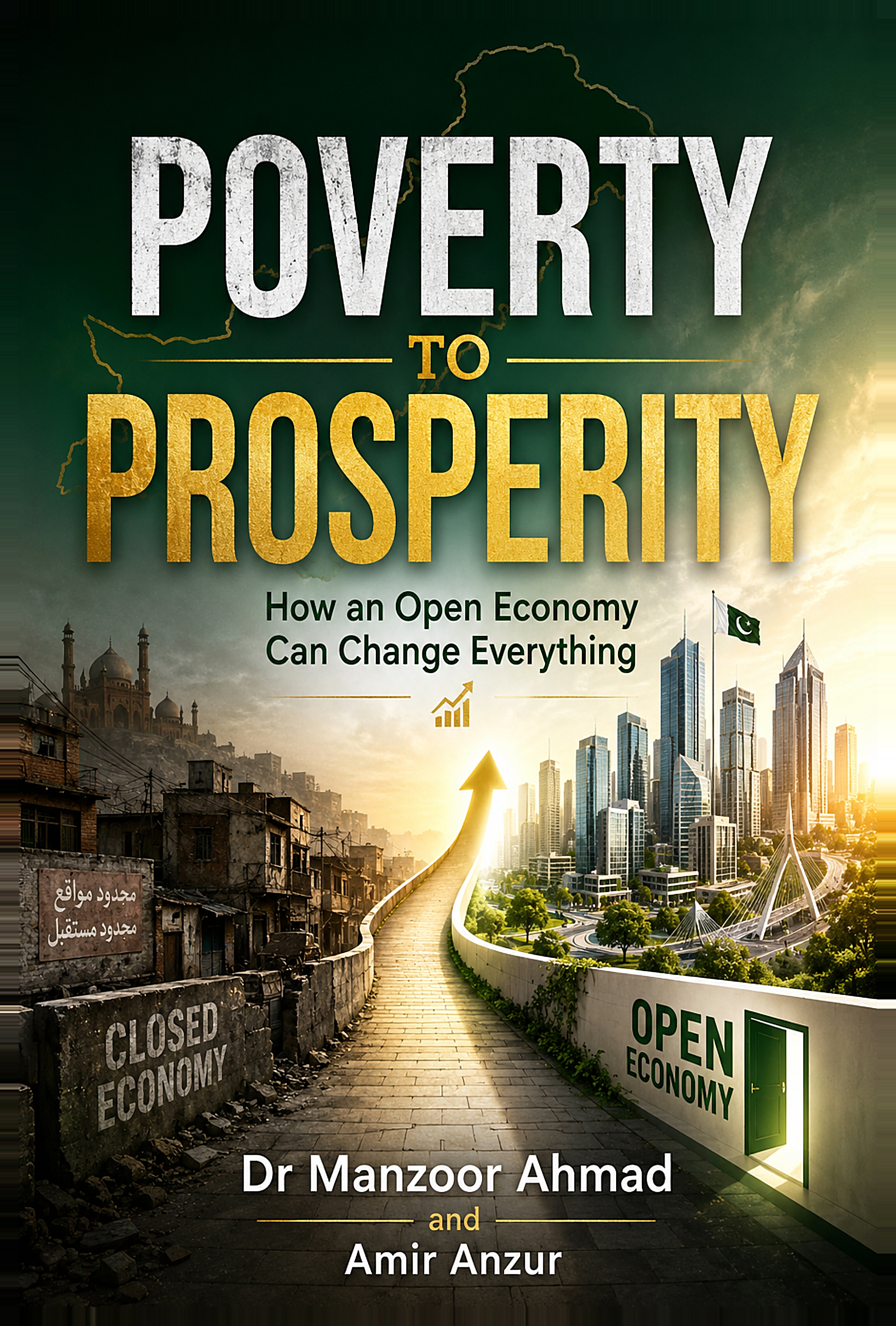
Poverty to Prosperity
How an Open Economy Can Change Everything
Ebook
$0
About this book
Poverty to Prosperity How an Open Economy Can Change Everything
Start with a puzzle.
Pakistan has the fifth largest population on Earth. It sits at the crossroads of Asia, with fertile land, mountains full of minerals, a long coastline and one of the youngest populations anywhere. Its people build software in Silicon Valley, run hospitals in Britain and send home tens of billions of dollars a year. A 26-year-old Pakistani just co-founded a company worth more than the country’s entire federal budget.
So why is Pakistan itself still poor?
Twenty years ago, Pakistanis earned more than Indians and Bangladeshis. Today they earn about three fifths as much. The country has gone back to the IMF roughly two dozen times in seventy years. Some people blame the world, the wars next door, or bad luck. Others say the country is simply cursed and the smart move is to leave.
This book gives a different answer, and it is backed by decades of evidence. Pakistan is poor because it built walls around its economy. High taxes on imports, permits for everything, and special favours for a small circle of protected businesses were meant to make the country strong. Instead they made its industries lazy, its products expensive and its exports tiny. While Vietnam and Bangladesh opened up and grew, Pakistan hid behind its walls and slowly fell behind.
The good news is that walls can come down. Countries that started poorer than Pakistan have transformed themselves within a single generation. Korea did it. China did it. Vietnam did it. And for the first time in decades, Pakistan has quietly begun taking its own walls down.
Written by a trade expert who spent fifty years inside the system and an entrepreneur who spent thirty years building businesses outside it, this book takes you on a journey. You will see how Pakistan got stuck and who benefits from keeping it that way. You will meet the comeback kids and the underdogs, from Ireland to Rwanda, and learn what they did differently. You will find out what the IMF merry-go-round really costs, why a budget is a mirror, and where the hidden opportunities lie, from rooftop solar to the creator economy to the giant markets next door.
No economics degree is needed. If you can understand how a shop works, you can understand how a country’s economy works. Every idea is explained in plain words, and every number tells a human story: a factory that never opened, a young woman who never got the job, a family that paid double for a fan in a heatwave.
The book closes with ten choices that could make Pakistan prosperous, a letter to the next generation, and a look at two very different Pakistans in 2047. Both are possible from where we stand today. Only one will happen.
Pakistan’s prosperity is not a mystery to be solved. It is a choice to be made.
“I finished the last page believing more in this country’s future than I did before I opened it.” Florian Walther
“Clear, fun, easy to read, and remarkably informative. A must-read for everyone, both in Pakistan and beyond.” Maria Pia Paganelli, Professor of Economics, Trinity University
“An enjoyable read, but also a book of hope for Pakistan.” Stefan Dercon, Professor of Economic Policy, University of Oxford